

A2O Windsor to Oamaru Bike Ride
29th May 2016.
After a good soaking of rain on the previous day, I decided to postpone the bike ride from
Duntroon to Kurow as there was a possibilty of water in the crossings of the Otekaieke, Otiake,
and Kurow riverbeds. Instead three keen riders set off from the carpark at 8am in fine but overcast
conditions to bike to Windsor and return on the Alps to Ocean Cycleway.
Bill met us at the Weston Limeworks, as we cycled on the old railway embankment and over an
impressive new bridge towards Enfield.
The track meandered through farmland and around small streams which had become swollen after
the recent rain. At Elderslie we admired a huge pile of foam that had builtup at the bottom of a
small waterfall.
Light rain began to fall as we took a break for morning tea outside the fire station at Windsor.
On the return to Oamaru we were met at the top of the Windsor hill by Bev and Dave and by this
time the rain had stopped.
We arrived back in Oamaru just after midday after cycling 42 kilometers
Thanks to John, Bill, Bev, Dave and Maurice for braving the unpredictable weather.
Phyllis.


Club Night May 2016
The AGM was held with President Jane Green being elected for another term. Over the last year, the Club has been busy with many walks and maintenance of the Herbert Forest. Wednesday Walkers have enjoyed walks in the Waitaki Valley. The Guest Speaker, Ian Davies, was the leader of saving indigenous trees in the Herbert Forest while he worked for the NZ Forest Service. From 1965, approximately 100 acres per year of gorse and native trees were burned to make way for Pinus radiata. The NZ Forest Service base was located in Dunedin and Ian asked them to consider a walking track which they agreed to, “for the loopies”. Ian then surveyed a track and when the weather was not suitable for forestry work, the employees worked on the track. This was the Podocarp Track established approximately 1968. School groups started to use the track and Ian became their Guide. In the early 1970’s, the Glenburnie and Hoods Creek Tracks were established by the Forestry. Thanks to Ian’s interest in indigenous trees and his initiative, many people have been enjoying these tracks for years and will continue to do so.
Kakanui Peak
Sunday the 15th May 2016
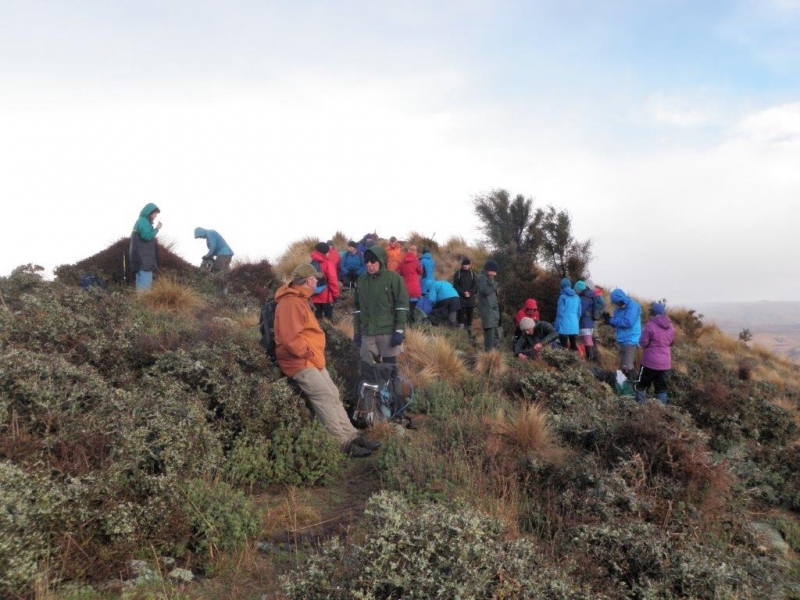
Seven of us meet at the car park at 7am on a cool and cloudy morning. The forecasts were for cloud in the morning and a wee bit of a shower in the afternoon. We all headed off with three more getting picked up on the way so by the time we regrouped in Palmerston our group of trampers was now eleven.
We drove through the Pigroot to the last crossing of the Shag River, just pass the Red Cutting Summit to park up in a clear area just off the road. I had decided that on this trip we would go up the ridge to the East and come down the leading ridge in the afternoon.
So at about 8.45am we headed off through the gate and followed the Shag stream to the start of a 4WD track that lead up the ridge. The track took us steadily up the ridge with the wind picking up a bit but with good views.
After about two hours we came across an old Skifield with an old ski hut, looking rather worse for wear and far from weatherproof, but still holding a number of old skis, old boots and a control box for the ski tow. Outside lay some old nutcracker belts and the ski rope lay along the line of the tow. We had morning tea here and had a good look around.
The wind was starting to get quite strong and cool, so off we headed following the old tow line to past a knob marking its top stanchion and up to a saddle which opened up some stunning views of Mt Dasher, Obi, Kattothyst and the Hectors Plateau. Just below the summit the wind dropped and it was quite pleasant till I took a look at our last 300m climb to the top.
We had to slog it through some very thick snow tussock with no animal tracks to follow but about 100m out it thinned out and the ground became rockier. The lower summit was passed and at 12.15pm we were on the top summit getting blown off.
Some photo’s were quickly taken at summit rock and then it was off to the side to find a tussock to hind behind to have lunch. John bought the record jar down from summit rock to have a look that it. Apart from the Wednesday Walkers it had been along time since the Tramping Club had been there. The records did show that a couple of our group had spent alot off time up there before, Linda and John. Lunch was had and we were starting to get cold so we signed the book, put it back on the summit and started to descent down the leading ridge.
The first part down was over stable scree and rock with a fierce westerly wind. Half of the way down was over tussocky ridges and humps to finally meet up with a 4WD track that took us down the ridge and over the shag creek and back to the cars, reaching them at about 2.45pm. The weather had held off with the sun trying to come out on our way down but it was very windy on top. It was an enjoyable day, with great views and great company.
Thanks to Maurice, Phyllis, Kate, Noel, Linda, Anna, Uwe, John, Jane and George on his first trip with the club. Neville


SouthTemple Side Stream Route Marking May7&8 2016
Upper South Temple, discussion previous day’s activity
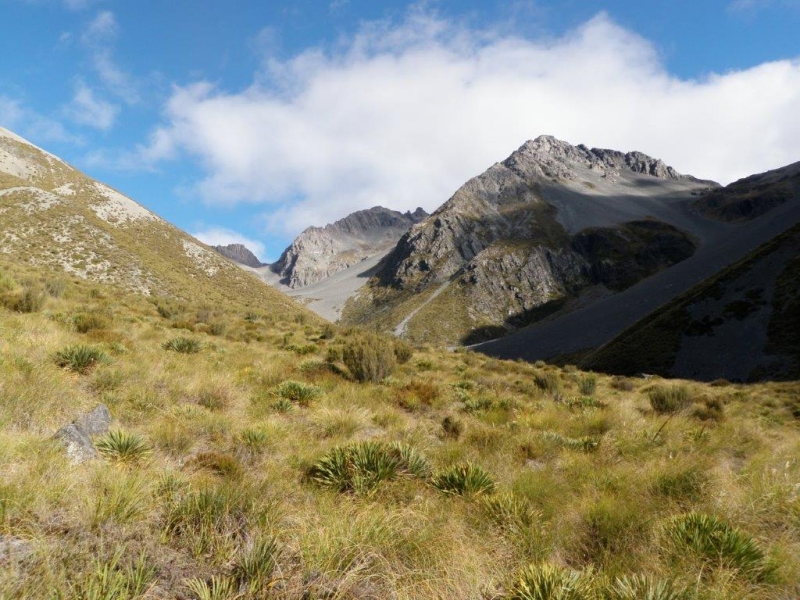
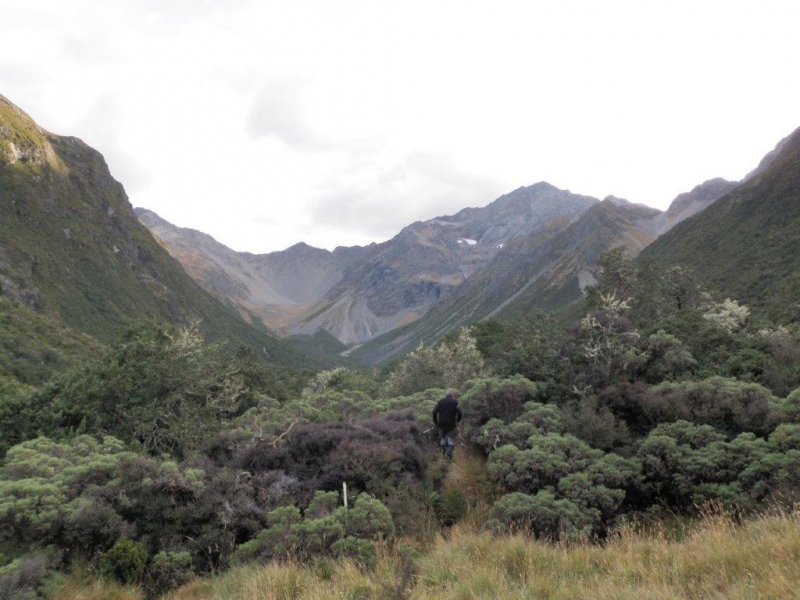
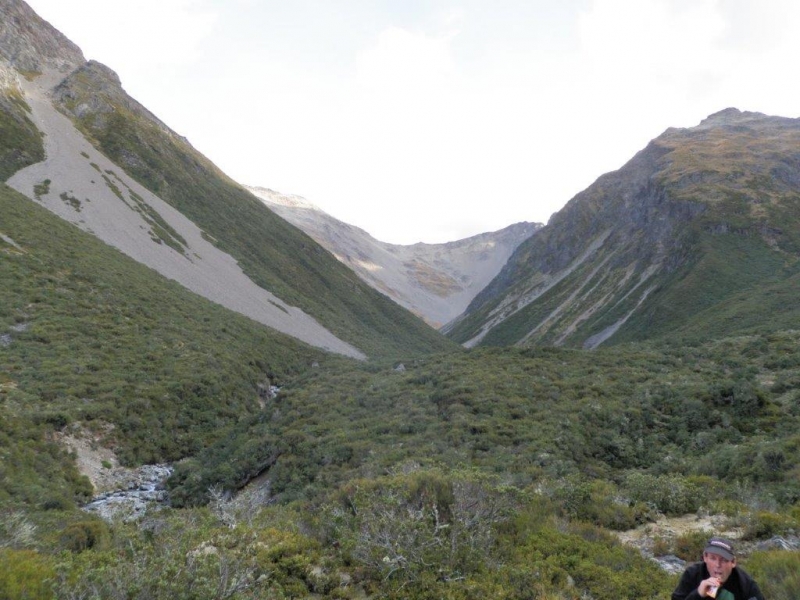
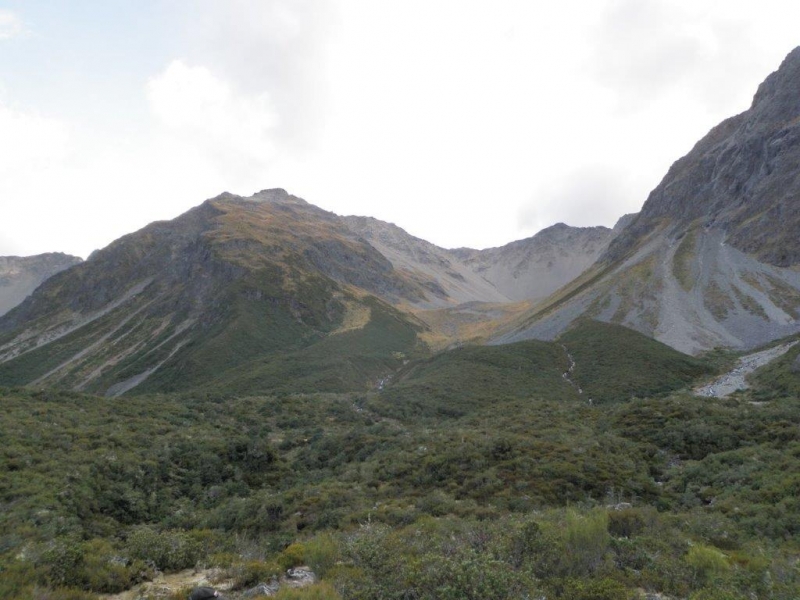
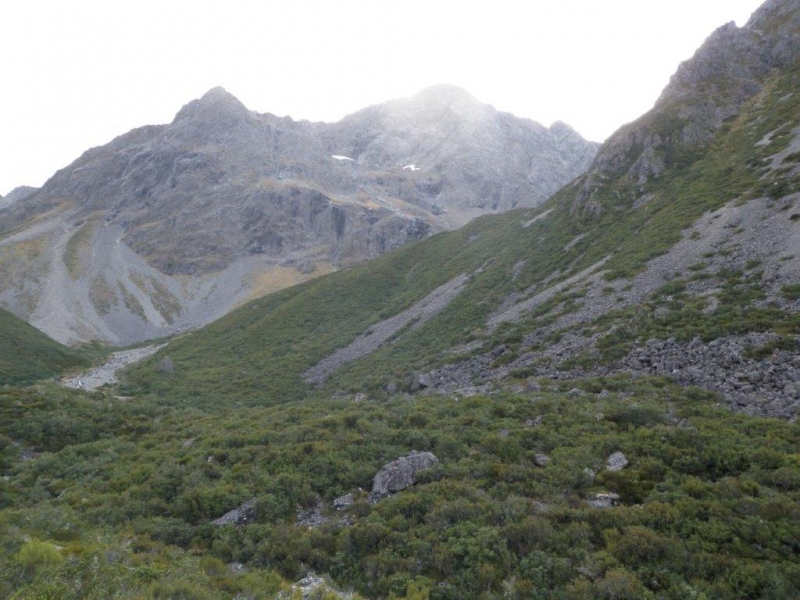
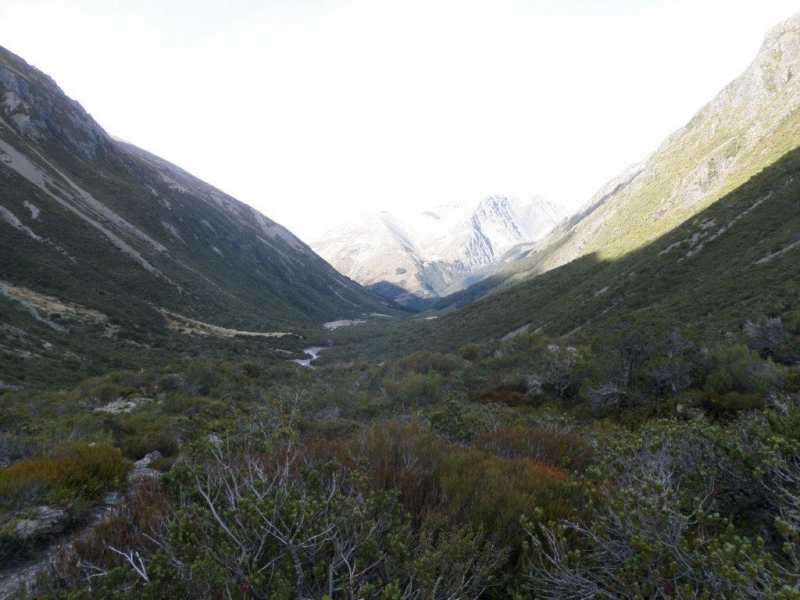
Seven arrived at the South Temple in 2 groups. Group 1 left Weston at 1pm Friday and Group 2 left town at 6pm. Group 1 walked into the South Temple Hut and arrive there just on dark and Group 2 camped the night at the Temple Shelter. Group 2 split further into Group 2A and Group 2B, Group A heading away at first light and arriving at the South Temple Hut at 9ish. Group 2B arriving there some time later. After pitching tents and refreshments, the now mostly combined party (minus 2B) set off up the unnamed branch that ends at the Hut, climbing steeply to reach the top of the tree-line and finding the large cairn put there on a previous occasion 4 years ago when we were last there marking out the same route. As it happened, the old markers were not too bad to locate even though they had faded badly to a silvery grey colour. Using the old markers we were able to tie new orange and pink plastic ribbon and reestablish this as a pretty good route to allow access into the upper basin of this stream which eventually leads around Mt Maitland and Watson Stream and the Ahuriri. Job done and we sat on our laurels in the sun on the hill opposite the Hut at about the bush line where some were so relaxed that they snored! Next day most were up and rearing to go for a walk up the South Temple. Group 2B remained for hut cleaning and other duties. We walked up the valley to where the track splits about 2 hours up and enjoyed the alpine atmosphere and the very mild weather. A return to the hut saw Group 2B departing for the carpark and the rest having lunch and packing up. The return to the carpark was well synchronised with everyone arriving within 5 minutes thereby minimising the exposure to the vicious squadrons descending upon us, some even hiding in the vehicle for a munch on the return journey. A good trip with good company and a good deed done. Thanks to John, Maurice and Phyllis, Jen, Karyl and Nev. Robbie
Club Night April 2016
The April Club meeting guest speakers were from DOC, Andy Powazynski and Tom Waterhouse. Based in Oamaru, they cover the area from Geraldine to Shag Point and inland to Kurow. They provided an overview of what DOC is actively doing in this region and with only three rangers and limited funds, resources are stretched to say the least. This is mostly due to the 2013 structural change within the department when 600 jobs were cut. The Earthquakes area is now owned by DOC and is getting a revamp however with the sink holes there, there are public safety issues. DOC, along with the Waitaki branch of the Forest and Bird Society have been planting Kowhai trees in the Gards Road area to preserve the uniqueness of this area. Also DOC is involved with the Cape Wanbrow native planting. Using a GPS, Tom mapped out the tracks in Trotters Gorge, provided it to the Asset Planner, however because only the Loop track existed originally, the other tracks will not be put onto new brochures/websites. DOC Tramping tracks in North Otago are getting maintained however, the squeeze is on and DOC’s mantra is to invite local groups who use these tracks to help maintain them, to the point of signing an agreement that the group will fund and maintain a track, to DOC’s standard of workmanship. Are volunteer hours a necessity to save our tracks?
Our next meeting is on the 9th May, AGM followed by Herbert Forest History, public are welcome. www.notmc.org.nz